
Offspring feeding time
|
|
MediRabbit.com is
funded solely by the generosity of donors. Every
donation, no matter what the size, is appreciated and will aid in the
continuing research of medical care and health of rabbits. Thank you |

|
Does do not typically feed their
newborns frequently. They visit the nest only once or twice a day. Feeding
time is limited to a few minutes. The amount of milk consumed by a healthy
newborn is sufficient to meet its needs for the next 24 hours. The rest of
the day, the newborns remain in the nest, where they can keep warm by
huddling together. After approximately 22 hours, they will become active and
move together to the surface of the nest. The doe remains in proximity to
the nest but enters it only during feeding time. This behavior is not driven
by a lack of maternal instinct; rather, it is a strategic avoidance of
attention to her nest and a deterrent for potential predators. After a thorough
environmental inspection, she will enter the nest and position herself over
her offspring, enabling them to feed.
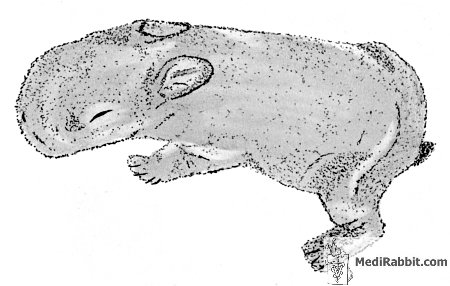
MediRabbit.com, after a photograph by Karen Comish Week old rabbit drinking milk During the feeding session, the
suckling rabbits attach within 3 to 9 seconds to a nipple, successfully.
During feeding, the kits alternate between different nipples at intervals of
approximately one minute. This remains unchanged until they reach 15 to 20
days of age, at which point the attachment to the nipple covered with saliva
is more rapid in comparison to those without saliva. After 3 to 5 minutes, the doe
leaves the nest. The kits will urinate and then reunite with their mother in
the nest for a 22-hour period. Chemical composition of rabbit’s milk (after Coates et al., 1964.
Brit J. Nutr, 18, 583-586):
Vitamin content (mg/ml) of rabbit’s milk at different stages of
lactation
At 10-15 days of age, kits begin
to transition to solid food, such as pellets and/or hay, in increasing amounts . This does not necessarily indicate that the
newborn can be weaned at this time.
Indeed, the maturation of the
gastrointestinal system is not yet complete. During the first weeks of a
newborn rabbit's life, the stomach and the anterior portions of the intestine
remain sterile, as they are not yet populated by intestinal bacterial flora.
This phenomenon is unparalleled in the animal kingdom. The pH of doe's milk
ranges from 5 to 6.5. This level of acidity is essential for bacterial
survival, as well as their growth and colonization of the intestine and
cecum. Rabbit milk is notable for its high content of C8 and C10 fatty acids,
which possess bacteriostatic properties. These molecules are sometimes
referred to as "milk oil," and their activation requires two
parameters: milk of the doe and stomach of the suckling. This treatment
protects day-old newborns against the growth of pathogen bacteria and, thus,
prevents the onset of necrotizing enteritis or generalized sepsis. Bacteria
that are absorbed during birth and via breastfeeding will survive the passage
through the stomach and intestine. These bacteria will then accumulate in the
cecum, the final section of the digestive system (colon), and the rectum. Once they reach a certain age,
young rabbits demonstrate increased strength and curiosity. They also tend to
leave the nest and begin consuming food they find along their journey. Until
the sixth week of life, a young rabbit will gradually decrease its milk
intake. Consequently, the concentration of milk oil in the stomach will
decrease, and the pH of the stomach will drop from about 5-6 to 1-2.
Microorganisms that are ingested will survive the stomach passage and begin
to grow and colonize rapidly in the cecum and the different sections of the
intestine. The initiation of fermentation in the cecum is dependent on the
presence of the appropriate bacteria. This final phase is of the utmost
importance. Indeed, the development of microorganisms within the
gastrointestinal (GI) tract is influenced by various factors, including diet,
type of forage, stress levels, and other environmental conditions. It is not uncommon
for pathogen bacteria, such as Clostridium sp., to colonize the
sterile digestive tract. This can result in severe diarrhea and even fatal
enteric illness. Therefore, it is essential to
maintain the newborn rabbit with the nursing doe until it reaches 8 weeks of
age. Separating them at 6 weeks or younger is not recommended. Once the
complex microbial flora has colonized the GI tract, it will help prevent the
development of pathogen bacteria. Acknowledgements I would like to express my gratitude to Karen Comish and Linda Baley
(USA) for their kind permission to use their material..
More information Anderson LC, Rush HG, Glorioso
JC. Strain differences in the susceptibility and resistance of Pasteurella
multocida to phagocytosis and killing by rabbit polymorphonuclear neutrophils.
Am J Vet Res. 1984; 45(6):1193-8. Coates ME, Gregory ME, Thompson
SY. The composition of rabbit’s milk. Br J Nutr. 1964;18:583-6. Dinsmore JE, Jackson RJ, Smith
SD. The protective role of gastric acidity in neonatal bacterial
translocation. J Pediatr Surg. 1997;32(7):1014-6. Glass RL, Troolin
HA, Jenness R. Comparative biochemical studies of milks. IV. Constituent
fatty acids of milk fats. Comp Biochem Physiol.
1967; 22(2):415-25. Harcourt-Brown F. Textbook of
Rabbit Medicine. Butterworth Heinemann, Oxford, 2002, p 55-56. Ogawa M, Shimizu K, Nomoto K,
Takahashi M, Watanuki M, Tanaka R, Tanaka T, Hamabata
T, Yamasaki S, Takeda Y. Protective effect of Lactobacillus casei
strain Shirota on Shiga toxin-producing Escherichia coli O157:H7
infection in infant rabbits. Infect Immun. 2001; 69(2):1101-8. Schley P. Rabbit milk -
composition and withdrawal of samples, Berl Munch Tierarztl
Wochenschr. 1975; 88(9):171-3. Van Camp JM, Drongowski
R, Gorman R, Altabba M, Hirschl RB, Coran AG.
Colonization of intestinal bacteria in the normal neonate: comparison between
mouth and rectal swabs and small and large bowel specimens. J Pediatr Surg.
1994;29(10):1348-51 |
|||||||||||||||||||||||||||||||||||||||||||||||||||||||||||||||||||||||||||||||||||||||||||||||||||||||||||||||||||


e-mail: info@medirabbit.com
