
Recommendation to ALL rabbit
owners:
Please monitor the weight of the
rabbit
Dr. Amir Maurer
Companion and Exotic Animal Veterinary
Center, Holon, Israel
|
|
MediRabbit.com is funded solely by the generosity of
donors. Every donation, no matter what the
size, is appreciated and will aid in the continuing research of medical care
and health of rabbits all over the world. Thank you |

|
Rabbits,
rodents, and birds can experience health problems that are not easily visible
or noticeable in their behavior. They may appear normal and show no signs of
illness, but it's essential to be aware of these potential health issues. It
is important to note that the progression of the disease, particularly dental
disease, will not be halted. The result can be detrimental to the animal's
well-being, potentially leading to secondary health concerns. Secondary effects
dental problems 1. Spurs, overgrown molars, deformed teeth can cause: - Damage
the gums and tongue, and possible secondary bacterial or yeast infections; -
Ptyalism (hypersalivation, slobbering) and secondary inflammation of
the skn (dermatitis) and alopecia. 2. Elongation of the roots of incisors or cheek teeth
can cause various problems: -
Compression or blockage of the nasolachrymal duct cause a runny eye or
dacryocystitis; -
Infection of the dental root, with development of a root abscess or a
retrobulbar infection; -
Infection of the root and deformation of the bone due to dissolution
of bone (osteolysis) or osteomyelitis; -
Dysplastic changes, e.g., pseudo-odontoma, that lead to compression of
the nasal cavity, difficult breathing, sneezing or “reversed” sneezing; -
Discomfort and/or pain caused by the dental problem leads to a
decreases appetite; -
Secondary renal failure, due to anorexia, hepatic lipidosis,
septicemia. 3. Signs of behavioral and dietary changes due to
discomfort or pain may include sudden aggressiveness or shyness, nibbling of
furniture, changes in food or litter habits, or licking a salt block that has
been ignored for some time. How can this be avoided To avoid
these tragic situations, it is advisable to purchase a digital scale and
weigh the animal on a monthly basis. To ensure the accuracy of the
measurement, the average of three consecutive measurements should be taken
and recorded. This will provide a more stable weight reading of the rabbit. A veterinary
examination should be scheduled when a 10% loss of stable body weight has
been recorded. This
effective method is of great assistance to veterinarians, enabling them to
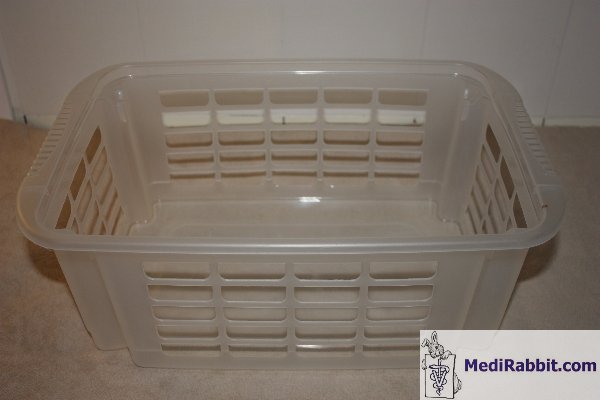
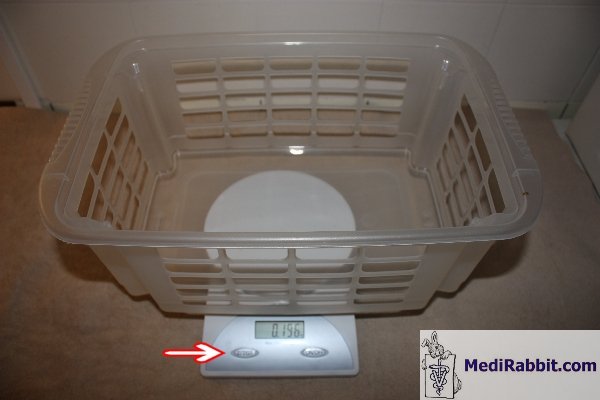
identify diseases in their early stages, particularly dental diseases. Material needed
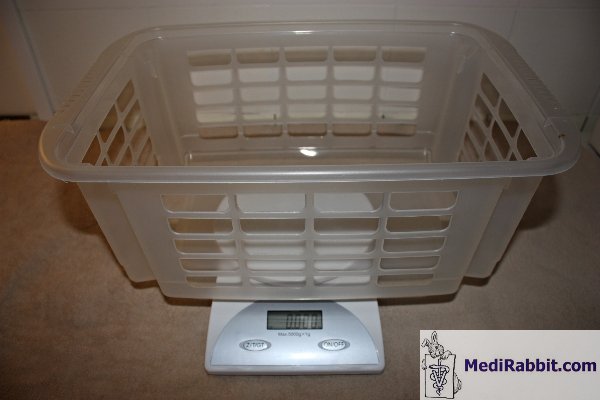
Tarring
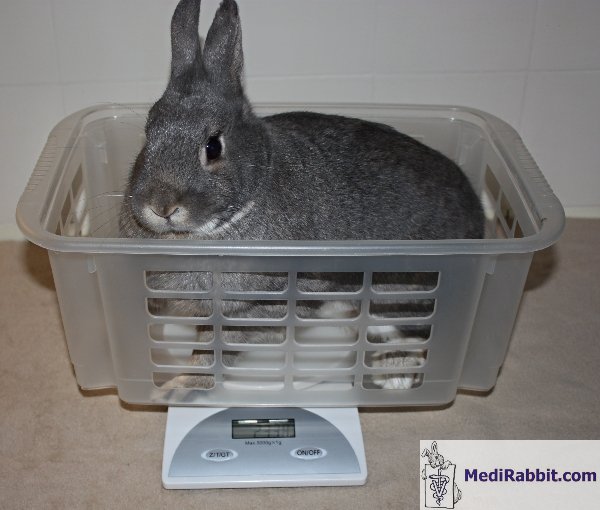
Weighing the
rabbit... Due to the fact that rabbits often
move within the box, which can result in inaccurate weight measurements on
the digital scale, it is recommended that several measurements be taken and
the average be calculated:
I would like
to express my gratitude to my rabbits Yara and Kaspi for their cooperation. |


e-mail: info@medirabbit.com
