
Phlebotomy
(blood drawing) in a rabbit
Esther van Praag, Ph.D.
|
|
MediRabbit.com is
funded solely by the generosity of donors. Every
donation, no matter what the size, is appreciated and will aid in the
continuing research of medical care and health of rabbits. Thank you |

Warning: this file
contains pictures that may be distressing for people.
Rabbits are
easily startled, and they may scratch or jump from the examination table
during a clinical examination or a blood sample. They frequently exhibit
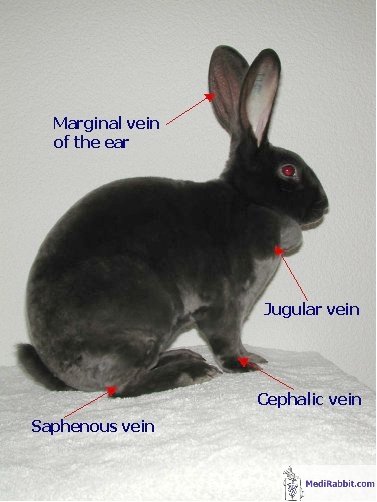
involuntary movements in response to venipuncture in the marginal vein of the
ear, particularly when the skin has not been anesthetized beforehand.
Therefore, it is advisable to restrain rabbits in a towel, bag, or laboratory
coat.
For a visual demonstration of restraint in a towel, please, see: Safe immobilization of
a rabbit in a towel (“rabbit burrito”)
The quantity of
blood required for a blood test will determine the location where the sample
will be collected. Veins are used for blood collection via venipuncture.
However, certain rare tests necessitate blood from the artery. It is
imperative to avoid arteries during this procedure, as it is associated with
significant discomfort and the potential for arterial vessel damage or
necrosis.
It is safe to draw up to 5 milliliters (mL) of blood from the
auricular marginal vein using a 23- to 25-gauge needle or a 23-gauge
butterfly attached to a syringe or tube. It is also possible to place a
catheter over a needle.
The preparation
of the skin remains consistent, regardless of the collection method employed.
Prior to the initiation of the sampling process, the fur on the ear is
meticulously shaved, and the skin is thoroughly cleansed with alcohol. Due to
the sensitivity of the skin on the ear, it is recommended to apply a local
anesthetic agent, such as a lidocaine-containing cream (e.g., EMLA®), to the
area.
The affected
area is wrapped with a plastic sheet and a protective adhesive bandage. After
45 minutes, the full thickness of the skin will be numb. The anesthetic
effect is effective for a duration of 60 minutes.
Dilation of the
vessel can be achieved through various methods, including massage of the ear,
the application of heat sources near the rabbit ear, or the use of blood
vessel dilating agents. One example of a blood vessel dilating agent that can
be used is acetylpromazine (0.25 ml, SC).
After the vein
is occluded, the needle is carefully inserted, and blood can be withdrawn.
The procedure must be performed slowly to prevent hemolysis of red blood
cells (erythrocytes), yet fast enough to prevent blood clots. After the
needle is removed, a cotton gauze is firmly applied to the site of
venipuncture for at least one minute, or until bleeding has stopped, in order to prevent the formation of hematomas and blood
clots. It is advisable to refrain from the use of alcohol-impregnated gauze.
Alcohol has been shown to cause vasodilation and hinder hemostasis.
Stains of blood on the ear can be removed using hydrogen peroxide.
It is essential to monitor the rabbit closely over the next few hours
to ensure that hemostasis is complete.
The jugular
vein can be used to collect a substantial amount of blood. The dewlap of
female rabbits does not pose a significant hindrance. The rabbit can be
positioned in a number of ways to ensure the
collection of blood from the jugular vein:
- sternal recumbency position, with the neck
extended upward and the front limbs hanging over the end of the examination
table;
- dorsal recumbency position, after safely
restraining the rabbit in a towel, and extending the neck in
order to expose the jugular vein;
- lateral recumbency position, with the neck
extended out and the front legs pulled downward.
If a rabbit
exhibits signs of respiratory distress, the jugular vein should be avoided
when collecting blood samples. It is possible that the patient will exhibit
cyanosis during the procedure.
Alternate sites
for blood collection include the cephalic and the lateral saphenous veins.
Their locations are consistent with those observed in dogs and cats. It is
important to note that these veins are fragile. As such, a hematoma can
easily form.
It is important
to avoid collecting blood from the central artery unless there is a need to
obtain a higher volume of blood. This site is associated with subsequent
distal ischemia, due to impairment of blood supply to the pinna after the
formation of a hematoma or due to blood vessel damage (arterial trauma with
thrombosis). It is important to note that excessive pressure may cause the
vessel to collapse. If the use of the central artery is unavoidable, the
21-gauge needle should be inserted as distally (at the tip of the ear) as
possible into the artery. The blood should begin flowing within the syringe
immediately.
Complete blood count
and biochemistry reference values in rabbits
Acknowledgement
I would like to express my gratitude to Akira Yamanouchi (Veterinary Exotic Information
Network), for the permission to his photograph.
I would also like to express my gratitude to my rabbits, Grijsje, Flora, and Stampi, for
their assistance and patience.
Further information
Mc Guill, M.W. and
Rowan, A.N. (1989) Biological effects of blood loss: implications for
sampling volumes and techniques. ILAR NEWS 31, No. 4, 5-18.
Exotic Companion
Medicine Handbook for Veterinarians, Cathy Johnson-Delaney and Linda
Harrison
Mader DR. Rabbits -
basic approach to veterinary care. In: Hillyer EV, Quesenberry KE (eds.):
Ferrets, Rabbits, and Rodents - Clinical Medicine and Surgery. Philadelphia, WB Saunders, 1997: 160-168.
Paul-Murphy J, Ramer JC. Urgent care of the pet rabbit. In: Rupley AE
(ed.): Vet Clin North Am (Exotic Anim Pract). Philadelphia, WB Saunders, 1998: 127-152.
|
|||||||||||



e-mail: info@medirabbit.com
