
Anal or anorectal papilloma
Esther van Praag Ph.D.
|
|
MediRabbit.com is funded solely by the generosity of donors. Every donation, no matter what the size, is appreciated and will aid in the continuing research of medical care and health of rabbits. Thank you |

Warning: this
file contains pictures that may be distressing for some persons.
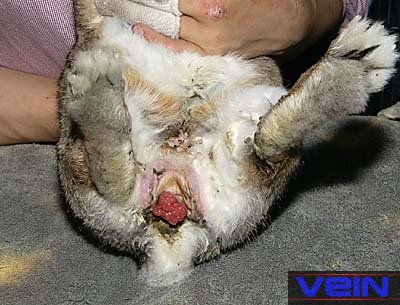
Small reddish excrescences may protrude from the anus of rabbits. The
origin of these tumors is not well understood, and they are not associated
with the papilloma viruses that cause oral or cutaneous papillomas
(Shope papilloma virus).
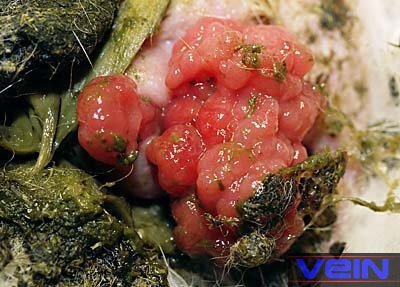
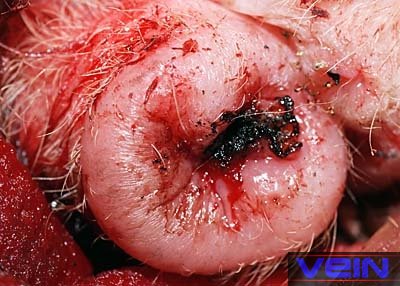
The cauliflower-like tumors develop at the mucocutaneous junction of
the rectum and the anus. The tumors are well differentiated and benign. In
the event of damage, they bleed profusely.
Clinical signs and
diagnosis
The presence of rectal or anal papilloma is a cause of discomfort.
Furthermore, these conditions can result in persistent, ineffectual spasms of
the rectum, leading to fecal tenesmus, or an inability to defecate. This can
result in an inaccurate diagnosis, such as stasis or inflammation of the
intestine (colitis).
Treatment
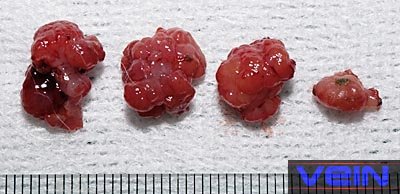
Spontaneous regression of the anorectal papilloma is a possibility. However, surgical removal of the tumor remains the preferred treatment option, as anal papilloma tumors are the result of premalignant transformations of squamous columnar cells of the anal or rectal mucosa. Ablative methods include classical surgical excision or destruction by laser, electrodissecation, or liquid nitrogen. If the growth is located in the rectum, it can be accessed by everting the rectum through the anus ("pull-out technique"). It is essential to remove the papilloma in its entirety, including the basis, to prevent recurrence. The tumor can be sent to a specialized laboratory for histopathologic analysis. If the tumor is invasive or displays cancerous characteristics, it should be excised with the widest margin possible. Post-surgical care includes the administration of NSAIDs, analgesics that reduce inflammation and control pain, as well as a diet rich in fiber. Prognosis is good.
Acknowledgement
Thanks are due to Akira Yamanouchi, for the permission to use the papilloma pictures from VEIN (Veterinary Exotic Information Network). Further Reading
Bourne D. Organisation Wildlife Information Network. https://www.wildlifeinformation.org/ Harcourt-Brown, F. Textbook of Rabbit Medicine. Publisher Reed Educational and Professional Publishing Ltd, Oxford, UK. 2002 Manning, P.J., Ringler, D.H. & Newcomer, C.E. The Biology of the Laboratory Rabbit - Second Edition. Publisher Academic Press Limited, 24-28 Oval Rd, London, UK. 1994 Quesenberry, K.E. & Carpenter J.W. Ferrets,
Rabbits and Rodents - Clinical Medicine and Surgery. 2nd Edition.
Publisher WB Saunders, Philadelphia, Pennsylvania, USA. 2004
|
e-mail: info@medirabbit.com
