
Tapeworms: rabbit as the definitive
host
Esther van Praag,
Ph.D.
|
|
MediRabbit.com is
funded solely by the generosity of donors. Every donation,
no matter what the size, is appreciated and will aid in the continuing
research of medical care and health of rabbits. Thank you |

Warning: this file contains pictures that may be
distressing for some persons.
|
Cestodes Several species
of flat-segmented worms, or tapeworms, have the capacity to infest wild or
domestic rabbits and wild lagomorph species, including the American
cottontail rabbit and hares. These worms can develop into mature, reproducing
tapeworms. These include: · Monoecocestus americanus, the porcupine tapeworm; ·
Ctenotaenia ctenoides; · Cittotaenia variabilis, the rabbit tapeworm; ·
Mosgovoyia pectinata
americana or M. perplexa; Tapeworm
infestation is a rare condition in pet rabbits, primarily caused by Cittotaenia variabilis. The life cycle of
these worms is not well understood at present. It is believed that infected
arthropods, such as oribatid mites (mites living in the soil), may act as
vectors for the transmission of the rabbit tapeworm, Cittotaenia
variabilis. The rabbit ingests the mites while grazing or consuming
contaminated hay. The larval form will develop in the abdomen and the liver.
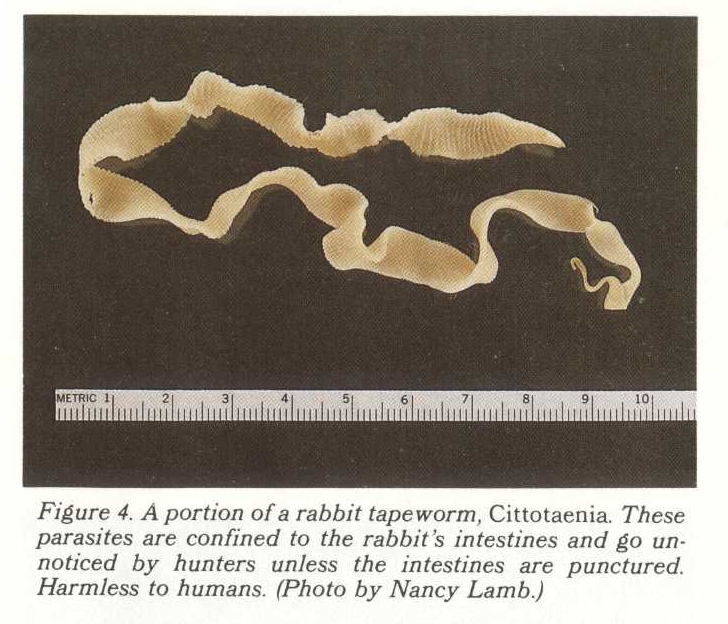
Adult stages of the parasite are found in the intestine. Its dimensions are 1
cm in width and 20 cm in length. Cittotaenia variabilis is distinguished by a
scolex (head) with four suckers that attach to the intestinal wall.
Clinical signs
If the number of
tapeworms is small, no clinical signs will be observed. In the event of a
severe infection, there may be indications of diarrhea, bloating, ileus, and
severe pain. It is possible that the rabbit will grow slowly and appear
abnormally thin despite having a normal appetite. Proglottis (reproductive
segments) can be found in the feces:
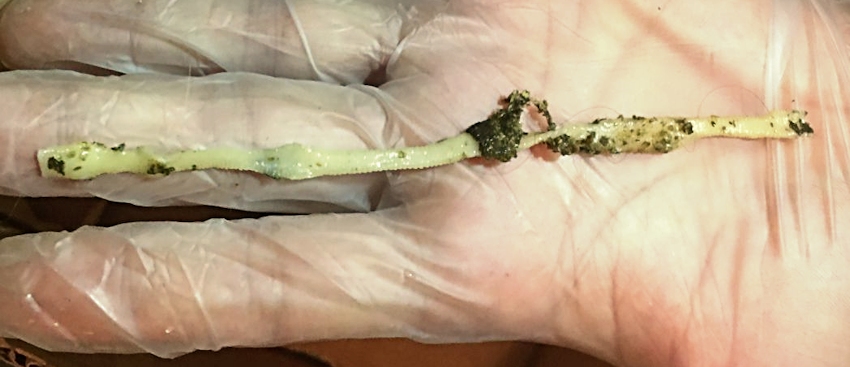
This is a specimen of a flatworm, potentially Cittotaenia
variabilis, that was discovered among the fecal matter of a pet rabbit. This rabbit is fed a diet of fresh dandelion and broadleaf plantain,
from the field, where wild cottontail rabbits can be observed. Picture: Wei in Massachusets (USA) In rare cases,
the worm may be visible protruding from the anus. A necropsy may
reveal ulceration at the site of the worm's attachment to the intestinal
wall. Tapeworms
affecting rabbits do not pose a zoonotic threat. Consequently, contact with
contaminated fecal material or proglottids does not result in the
transmission of these parasites to humans. Treatment
Please consult the following list to understand the meaning of the
abbreviations, click here.
Following treatment with praziquantel, the remaining portion of the
tapeworm has been expelled.
The expelled worm is covered by fecal material and mucus. Picture: Wei
Good sanitation of the
living environment of the rabbit is also necessary. Acknowlegement
I would like to express our gratitude to Wei
in Massachusetts, USA, for sharing this rare finding with her rabbit, Bunbun, and for granting me permission to use the
pictures. Further information:
Manning
et al. The biology of the laboratory rabbit. 2nd ed. London, UK,
1994. Sadler
KC. Common diseases and Parasites of Cottontails, Missouri Dept. of
Conservation. Pinto
RM, et al. Helminths of rabbits (Lagomorpha, Leporidae) deposited in the
Helminthological Collection of the Oswaldo Cruz Institute. Rev. Bras. Zool. 2004, v. 21, n. 3, pp. 599-604. Soltysiak Z, Bednarski M, Piekarska J. Wagrzyca watroby
królika. Medycyna Wet. 2007, 63:1255-1257. |



e-mail: info@medirabbit.com
