
Trichostrongylus
calcaratus
Esther van
Praag, Ph.D.
|
|
MediRabbit.com is funded solely by the generosity of
donors. Every donation, no matter what the
size, is appreciated and will aid in the continuing research of medical care
and health of rabbits.
Thank
you |

|
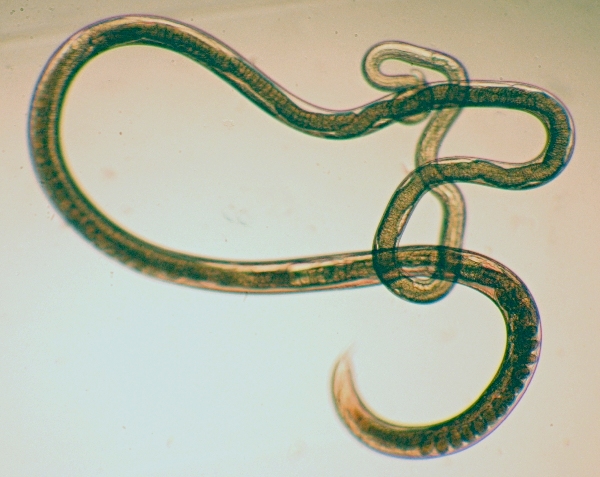
Trichostrongylus parasitic worms are frequently observed infesting
wild rabbits and cottontails, particularly the eastern cottontail (Sylvilagus
floridanus) in the USA. These parasites are uncommon in pet rabbits. Trichostrongylus calcaratus
is found in the small intestine and the colon of the rabbit. The
extra-intestinal migration remains to be fully elucidated. The rabbits become
infested by consuming food (hay, straw, fresh vegetables) that has been
contaminated by the larvae. This parasite does not represent a public health
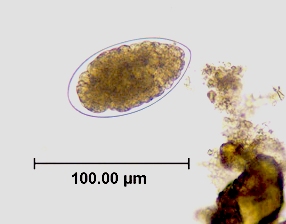
danger. The eggs
produced by the female will pass in the feces and hatch outside the host.
These measurements are typically between 80 and 90 micrometers in length. The
eggs are already segmented at the time of laying and develop into infective
larvae within six days. The L1 and L2 stages of the larvae are microbivores.
The L3 stage, which is reached after 16-18 days, is non-feeding and infective
by ingestion. The L3, L4, and L5 stages are immature adults that develop into
mature forms within the digestive tract of the host. The life cycle is
direct, with no intermediate hosts. The worms are slender, with small
anterior ends and no buccal cavity. Male worms are distinguished by their
asymmetrical dorsal ray and two short, nearly equal spicules. The female has
a vulva measuring approximately 1 millimeter near the tip of the tail. It is
possible to observe the presence of spherical-shaped eggs in her body.
Several Trichostrongylus species have
been observed in rabbits. The differentiation of these species is based on
their size and the structure of the spicules. Trichostrongylus affinis
This strongyle parasitic worm is found
throughout the USA and has been identified in cottontails (Sylvilagus
floridanus) and snowshoe hares (Lepus americanus). It is a rare
occurrence in pet rabbits. This parasite infects the cecum and the large
intestine. The eggs, with an average measurement of
61 x 37 micrometers, will be excreted alongside the fecal matter. The larvae
hatch and develop outside the host, becoming infective after approximately 10
days. The adult worms have an average size of 5-7.5 millimeters for males and
8.7-9.3 millimeters for females. Males are equipped with spicules, while the
posterior end of the female is characterized by a vulva. Severe infestation can lead to a loss of body
weight. Trichostrongylus retortaeformis
This parasite is endemic to Europe and
the UK, and it was introduced to Australia. It is found in the small
intestine of rabbits and hares (Lepus europaeus). Its life cycle is
likely comparable to that of Trichostrongylus
affinis. The presence of Trichostrongylus
retortaeformis in a population of rabbits can
affect and reduce its size. The eggs measure approximately 87 by 33
micrometers. They are found in the portion of the herbage that experiences
the least climatic changes. Their development is stopped at temperatures
under 10°C. The larvae can migrate within the vegetation to moist conditions.
The adult worms measure between 6.8 and 8.4 millimeters long for the males
and 9.6 and 10.4 millimeters long for the females. They are characterized by
the presence of thin transverse and longitudinal grooves. The clinical test includes fecal
flotation at 25°C. Higher temperatures will result in the killing of the
parasite. Trichostrongylus ransomi
Trichostrongylus ransomi has been reported in cottontails (Sylvilagus
floridanus) in Louisiana, USA. This parasite is not prevalent in rabbits.
It is known to infest the small intestine. The life cycle of this worm is not
yet fully understood, but it is believed to be like that of T. affinis. The eggs of this parasite measure
approximately 65 by 33 micrometers. The adult worms are small, measuring
2.2–3 mm for males and 3–3.5 mm for females. Trichostrongylus colubriformis (T. instabilis)
This cosmopolitan parasite infects the
small intestine of cattle and other ruminants, as well as lagomorphs. Clinical signs
The
intrinsic pathogenic strength of these worms is weak, and most rabbits remain
asymptomatic. However, severe infestation can lead to weight loss and/or
anemia, as well as the exacerbation of other rabbit disorders, such as
diarrhea and severe eosinophilia. In some cases, it can even result in death.
The mucous layer of the intestine is often irritated, which can lead to blood
loss. In certain instances, the presence of nodules may also be observed. The presence of Trichostrongylus
worms is diagnosed by fecal flotation for the presence of strongyle-type eggs
in the feces. The cultivation of these eggs to the L3 stage is essential for
accurate species identification. Adults can be distinguished by their
anatomical structure and appendices. Treatment
Further Information
Anderson RC (2000) Nematode Parasites of Vertebrates.
Their Development and Transmission. 2nd Ed. CABI Publishing, Oxon,
UK. Andrews CL,
Davidson WR. Endoparasites of selected populations of
cottontail rabbits (Sylvilagus floridanus) in the southeastern United
States. J Wildl Dis.
1980; 16(3):395-401. Audebert F,
Cassone J, Hoste H, Durette-Desset MC. Morphogenesis and distribution of Trichostrongylus retortaeformis
in the intestine of the rabbit. J Helminthol. 2000; 74(2):95-107. Audebert F,
Hoste H, Durette-Desset MC. Life cycle of Trichostrongylus
retortaeformis in its natural host, the rabbit (Oryctolagus cuniculus).
J Helminthol.
2002; 76(3):189-92. Boag B. The incidence of helminth parasites from the wild rabbit Oryctolagus
cuniculus (L.) in eastern Scotland. J Helminthol. 1985; 59(1):61-9. Boag B, Iason
G. The occurrence and abundance of helminth parasites
of the mountain hare Lepus timidus (L.) and the wild rabbit Oryctolagus
cuniculus (L.) in Aberdeenshire, Scotland. J Helminthol.
1986; 60(2):92-8. Ciordia H BIZZELL WE, Porter DA, Dixon CF. The effect of culture temperature and age on the infectivity of the
larvae of Trichostrongylus axei and T. colubriformis in
rabbits and guinea pigs. J Parasitol. 1966; 52(5):866-70. Duwel D,
Brech K. Control of oxyuriasis in rabbits by
fenbendazole. Lab Anim. 1981; 15(2):101-5. Hoste H,
Reilly M. Scanning electron microscopy of the
jejunal and ileal mucosa of rabbits infected with Trichostrongylus
colubriformis. Ann Rech Vet. 1988; 19(2):123-8. Hoste H,
Mallet S. Effects of size of Trichostrongylus
colubriformis infections on histopathology of the mucosa along the whole
small intestine in rabbits. Hoste H,
Mallet S, Koch C. Trichostrongylus colubriformis infection in rabbits:
persistence of the distal adaptive response to parasitism after anthelmintic
treatment. J Comp Pathol. 1995; 113(2):145-53. Iason GR,
Boag B. Do intestinal helminths affect condition and fecundity of adult
mountain hares? J Wildl Dis. 1988; 24(4):599-605. Molina X,
Casanova JC, Feliu C. Influence of host weight, sex and reproductive status
on helminth parasites of the wild rabbit, Oryctolagus cuniculus, in
Navarra, Spain. J Helminthol. 1999; 73(3):221-5. Prasad D, The
effects of temperature and humidity on the free-living stages of Trichostrongylus retortaeformis. Can.
J. Zool. 1959; 37: 305-316. Purvis GM,
Sewell MM. The host-parasite relationship between
the domestic rabbit and Trichostrongylus colubriformis. Vet Rec.
1971; 89(5):151-2. Strohlein DA,
Christensen BM. Metazoan parasites of the eastern
cottontail rabbit in western Kentucky. J Wildl Dis. 1983; 19(1):20-3. Wiggins JP,
Cosgrove M, Rothenbacher H.Gastrointestinal parasites of the
eastern cottontail (Sylvilagus floridanus) in central Pennsylvania. |
||||||||||||||
e-mail: info@medirabbit.com
