
Case report: hepatic steatosis
(fatty liver) in a rabbit
Esther van Praag, Ph.D.
|
|
MediRabbit.com is
funded solely by the generosity of donors. Every
donation, no matter what the size, is appreciated and will aid in the
continuing research of medical care and health of rabbits. Thank you |

|
The liver is one of the largest organs in the
rabbit. It plays an essential role in the body's energy metabolism by processing
nutrients, burning fat, filtering blood from the digestive system, and
detoxifying molecules that may cause harm to body tissues.
Hepatic steatosis, also known as fatty liver
disease, is the abnormal accumulation of fat within liver cells. While the
name of the disease may imply a link to fat, it is predominantly triggered by
a diet high in carbohydrates, not fat. This results in an accumulation of fat
in the liver cells, replacing healthy tissue. Instead of processing fats and
expelling the excess, a fatty liver will begin to store fat in its tissues.
The accumulation of fat in liver cells can disrupt liver function and
metabolism. Impaired liver function can lead to the accumulation of cellular
waste products and toxins in the blood.
Fatty liver disease has been observed in obese
rabbits. The etiology of this disease is not well understood. Obesity, diets
with excessive fructose (a sugar found mainly in fruit), and carbohydrates
(oat), an underactive thyroid gland (hypothyroidism), and lack of exercise
are commonly observed. Additional factors that contribute to fatty liver
disease in rabbits include: ·
Anorexia, refusal to take in food caused by dental
disease or digestive disorders; ·
Lack of fiber in the diet; ·
Sickness in obese rabbits; ·
Gestation; ·
Toxins released by certain bacteria, e.g., Escherichia
coli. Its toxins can lead to a transient increase of free fatty acids in
the blood. Clinical signs
There are no clinical signs associated with hepatic
steatosis in rabbits. Fatigue, discomfort, anorexia, depression, and/or
jaundice may be observed in cases where fat constitutes approximately 10% of
the liver's weight. Waste of muscle tissue is observed and can lead to
reluctance to move and exercise. Diagnosis
The diagnosis of hepatic steatosis is based on a
visual examination and a complete blood test. Radiography and ultrasound of
the chest and abdomen can assist in determining the shape and size of the
liver, as well as the extent of fat accumulation in the liver. It is possible to detect the presence of gallstones
composed of excess cholesterol. Blood panel
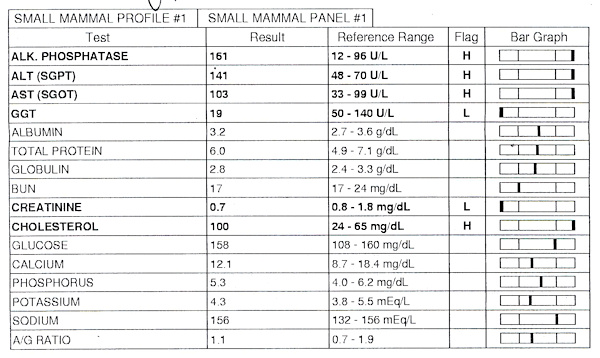
A blood panel test can indicate
elevated liver enzyme levels, suggesting the presence of liver inflammation. The
process of fat oxidation can result in liver cell damage, membrane rupture,
and the leakage of liver enzymes into the bloodstream. Typically: ·
Alkaline phosphatase (Alk phosphatase) is elevated. ·
Alanine transaminase (ALT) is elevated. ·
Aspartate transaminase (AST) is in the so-called
"grey zone", just above the reference range. The AST/ALT ratio is lower than
zero (in this case: 103/141 = 0.73). This is indicative of viral liver
disease or steatosis/fatty liver disease linked to obesity. In this case, there is no liver
failure yet. Indeed, gamma glutamyl transpeptidase (GGT) is decreased and
below average. This marker is more sensitive than ALT and AST to liver
damage, but less specific. In case of damage GGT increases rapidly. Hyperlipidemia and elevated
triglycerides are common complications of fatty liver disease. The elevated
cholesterol levels, indicative of cholesteremia,
remain unexplained. In rabbits, this condition is often linked to liver
failure, obesity, and, in rare cases, a diet high in fat in pet rabbits. Glucose levels are elevated, but within the
acceptable range, which eliminates the possibility of insulin resistance
commonly associated with obesity-related diabetes. Elevated glucose levels in
rabbits during examination are frequently indicative of stress.
An elevated blood level of monocytes is nowadays
believed to be a marker for fatty liver disease (e.g. obesity).
Treatment
It is imperative to implement
immediate measures to rectify the liver damage and eliminate the excess fat
in that organ. The treatment of fatty liver disease is a prolonged process.
The objective is to reverse hepatic fat metabolism. The duration depends on
the extent of fat accumulation. In rats fed a diet high in carbohydrates, it
has been demonstrated that they developed fatty livers in proportion to the
amount of sugar fed. This can also be accompanied by insulin resistance. The rabbit should not receive any
further carbohydrate-rich food and treats. Instead, it should receive a
healthy fiber-rich diet, rich in hay (see: Rabbit feeding
for suggestions). It is imperative that obese rabbits
lose weight. This process is gradual. It involves a 5 to 10% loss of initial
body weight over the next six months. The administration of milk thistle (Sylibum marianum) extracts has
been shown to promote the healing and recovery of liver cells. If the diet is not corrected, the
liver tissue will be progressively replaced by scar tissue. This will prevent
the normal circulation of blood within the organ. Fibrosis and regenerative
nodules (lumps) are the result of a process in which damaged tissue is
regenerated. These nodules will develop and replace the healthy liver tissue,
leading to loss of liver function (cirrhosis) and liver failure. During the recovery process,
weight loss may not be linear and gradual. It is possible that the process
will pause for a period of several weeks, after which it will resume and gain
further momentum. This is a typical occurrence and does not indicate a halt
in the recovery process. It is important to note that the level of liver
enzymes in the blood may fluctuate before it decreases to
normal. The prognosis for hepatic steatosis is guarded,
especially in older rabbits. |
||||||||||||

e-mail: info@medirabbit.com
