
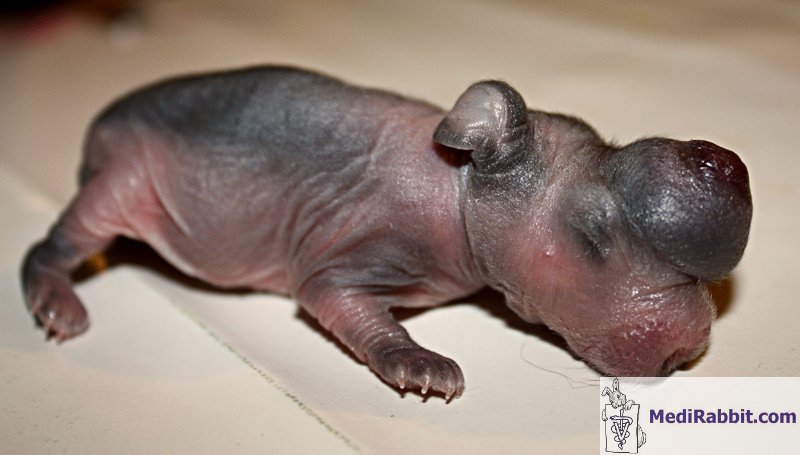
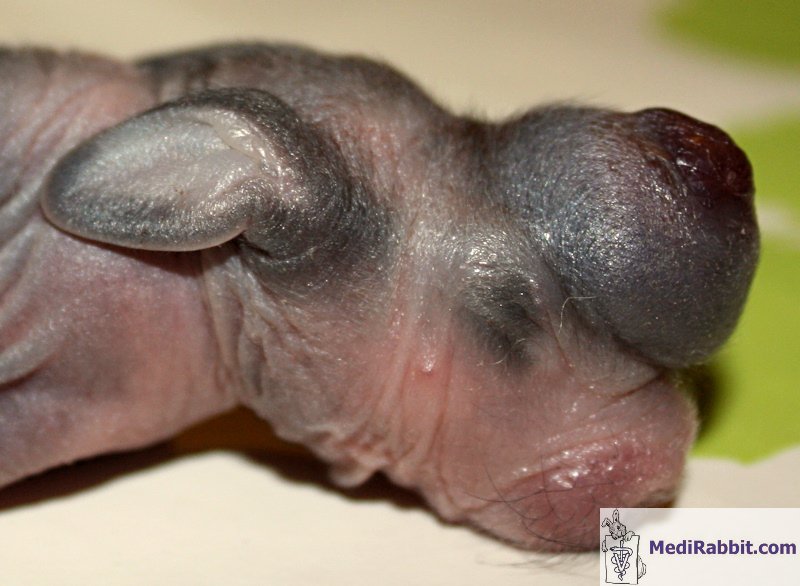
Rabbit newborn with frontal
encephalocele
Esther van Praag, Ph.D.
|
|
MediRabbit.com is funded solely by the generosity of
donors. Every donation, no matter what the size,
is appreciated and will aid in the continuing research of medical care and
health of rabbits all over the world. Thank you |

It is rare that a
newborn rabbit presents with a deformation of the head. There are two
possible origins for this issue: either it is hereditary or it is linked to a
developmental defect of the fetus. Encephalocele is a condition that arises
from an abnormal development of the neural tube during the early stages of
gestation. This defect is associated with an autosomal recessive gene that is
expressed at the level of the spinal cord (spina bifida) or the skull
(encephalocele).
At the skull level, this defect impedes the proper
closure of the skull bones and the skull. This incomplete closing is located
at the sagittal level, between the forehead and the nostrils. A protrusion,
also known as a hernia of the skull, contains part of the brains and
sometimes the membranes that surround and protect the brain and spinal cord.
At the time of
writing this article, Geelen's 1974 study is the only one to provide a
detailed account of hydrocephalus in a rabbit. In this case, the
three-week-old rabbit was the result of inbreeding.
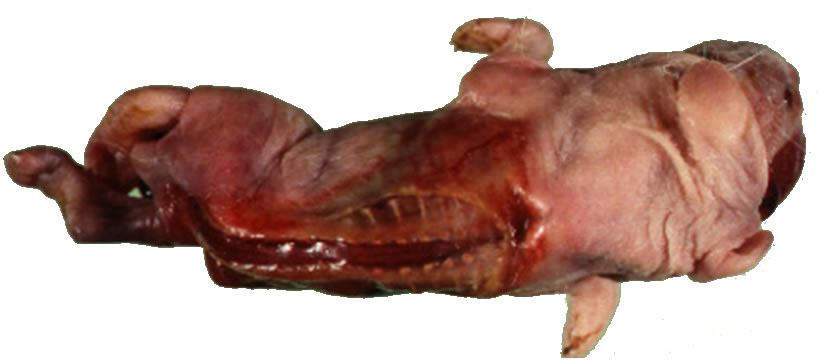
This one-day-old
newborn rabbit is one of eleven offspring of a female Belgian Beard rabbit,
an older breed that became almost extinct. Although it was alive and active,
yet, the decision was made to humanely euthanize the newborn, as its
prospects for survival in a 11-member nest were dismal and further suffering
would be inflicted upon it.
Acknowledgement I
would like to express my sincere gratitude to Michel Gruaz of Switzerland for
sharing information regarding this rare defect in a newborn rabbit. Further information Geelen JAG. A
case of hydrocephalus and meningo encephalocele in
a rabbit caused by aqueductal malformation. Laboratory Animals (London) 1974 : 167-176.
|
e-mail: info@medirabbit.com
