
Osteophytes, Bone spurs, Bone outgrowth
|
|
MediRabbit.com is
funded solely by the generosity of donors. Every
donation, no matter what the size, is appreciated and will aid in the
continuing research of medical care and health of rabbits. Thank you |

|
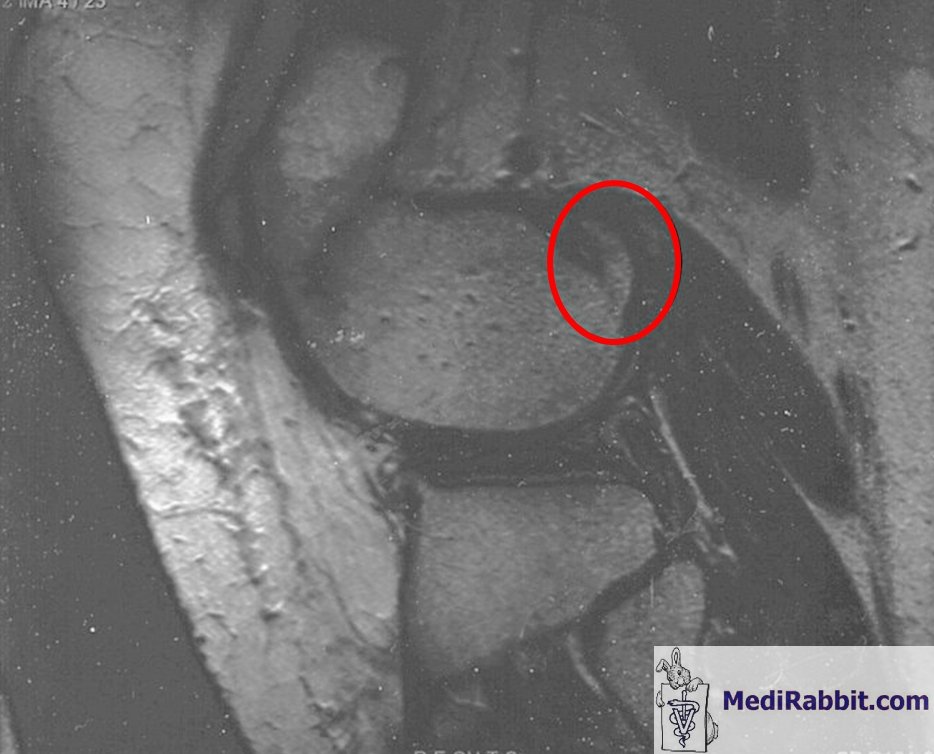
E. Besomi Magnetic Resonance Imaging (MRI) of an osteophyte in the human
knee joint (inside circle) Bone spurs, also known as
osteophytes, are a result of bone growth, typically occurring in areas where
the bone is under abnormal pressure. The term "spur" is the
official designation. Bone spurs are characterized by their round, smooth
structure with a slow growth rate. As the growth reaches a certain size,
there is a possibility that it will compress the adjacent blood vessels and
nerves. The condition is characterized by the onset of pain and inflammation,
with a low likelihood to cause muscular atrophy. These are typically observed
in the joints and spine. The initial treatment includes
usually rest, and the administration of pain medication. NSAID analgesics
(e.g., meloxicam) are drugs of choice as they reduce both the pain and the
inflammation caused by bone spurs. The pain medication does not need to be
given on a daily basis, once or twice a week may be enough. Removal of
osteophytes is a last resort surgery. Indeed, this kind of surgery may worsen
the problem, in other cases the bone spurs are placed in such difficult
location that it is impossible to reach them for surgical removal. Since a few years, glucosamine/chondroitin
has been used to manage arthritis in rabbit. For rabbits, the recommended dosage
of Cosequin can be found in Carpenter's formulary.
The product is to be used "at feline dose, as demonstrated by empirical
evidence." Specifically, we administered Cosequin
to our rabbit, starting with a dosage of 1/4 teaspoon twice daily. After one
month, it was transferred to the SID for maintenance. Regarding Adequan, the recommended
dosage is 2.2 milligrams per kilogram of body weight, administered via
subcutaneous (SC), intra-muscular (IM), or intravenous (IV) injection, once
per week for a period of four weeks, followed by a maintenance dose every
fourteen days. It is important to note that these
products do not provide immediate relief. Typically, a period of four weeks
is required for their positive effects to become apparent. Cosequin and Adequan are not effective in
addressing pain, so the use of pain medication is recommended. Meloxicam
(Metacam) is frequently administered. The pain medication does not require
daily administration; once or twice a week may be sufficient. There are no
established guidelines; rather, it is an observation of the rabbit and the
detection of any indications of discomfort or pain. Based on the rabbit's behavior, its habits, eating patterns, and mobility,
adjustments can be made to the pain medication schedule. In one case, the
rabbit exhibited regular relapses. In such cases, ketoprofen was administered
as required. Typically, one or two injections were sufficient. This article also describes other
NSAID analgesic drugs that are used in rabbits here. Acknowledgement
Thanks
are due to Frau E. Besomi and Akira Yamanouchi, VEIN (Veterinary Exotic Information
Network), for their permission to use their pictures. Further information: Williams JM, Zhang J, Kang H, Ummadi V,
Homandberg GA. The effects of hyaluronic acid
on fibronectin fragment mediated cartilage chondrolysis in skeletally mature
rabbits. Osteoarthritis Cartilage. 2003 Jan;11(1):44-9. |
e-mail: info@medirabbit.com
