
Mange:
burrowing mites
Sarcoptes scabiei or Notoedres cati
Esther van Praag, Ph.D.
|
MediRabbit.com is
funded solely by the generosity of donors.
Every
donation, no matter what the size, is appreciated and will aid in the
continuing research of medical care and health of rabbits.
Thank you
|

Warning: this file contains pictures that may be distressing
for people.
Rabbits
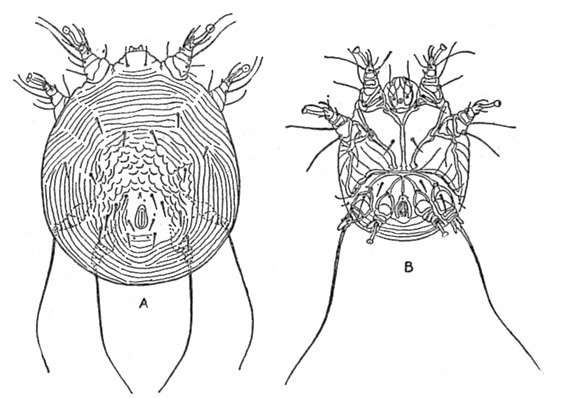
can be affected by mange, caused by burrowing mites. Sarcoptes
sp. is encountered all over the world, though not with equal frequency.
Rabbits in northern Europe and England are barely affected by mange; in
Israel and subtropical humid regions, they appear the number one cause of
skin parasitic infestations in rabbits. In the US it varies according to the
region. Burrowing mites present a zoonotic danger; they can affect dogs,
cats, and humans, causing a transient itching dermatitis. The burrowing mange
Notoedres cati
is occasionally observed to infest rabbits.
These
parasites spread rapidly from one rabbit to another, through nymphs and larvae
that live on the surface of the skin. Only the adult female will dig into the
skin and make tunnels where it lays up to 5 eggs, with a maximum of 50 during
her whole life. The larvae that hatch from those eggs live the first stages
of their life in those tunnels. Only the male adults and older larvae live on
the surface of the skin. The complete life cycle from egg to adult lasts
about 2 to 3 weeks. This should be taken into account when treating a rabbit.
Symptoms
and clinical signs
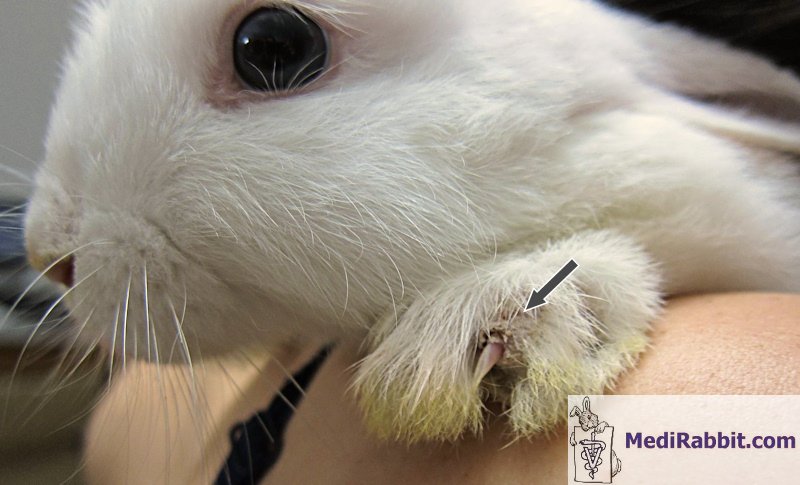
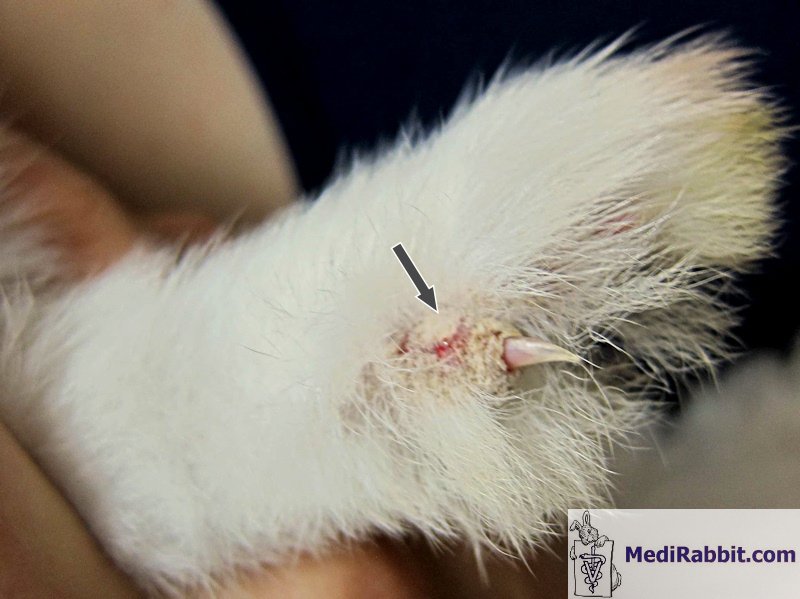
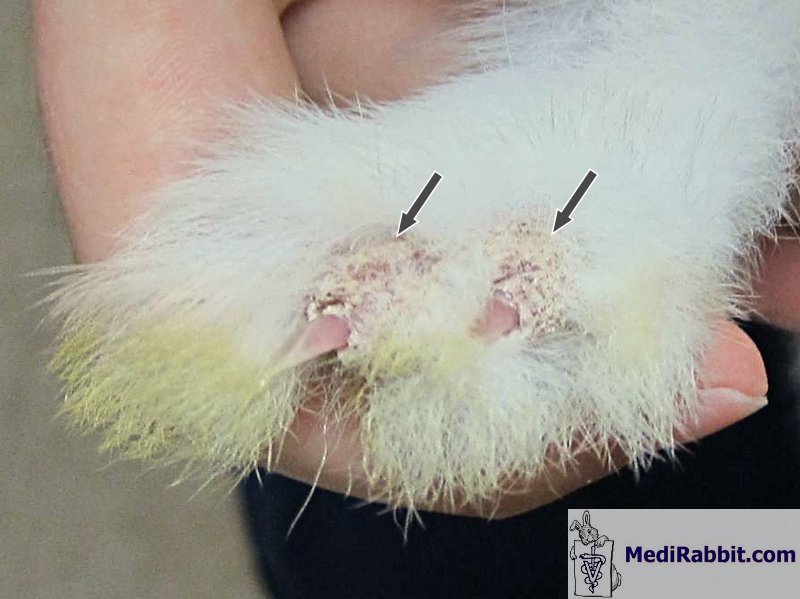
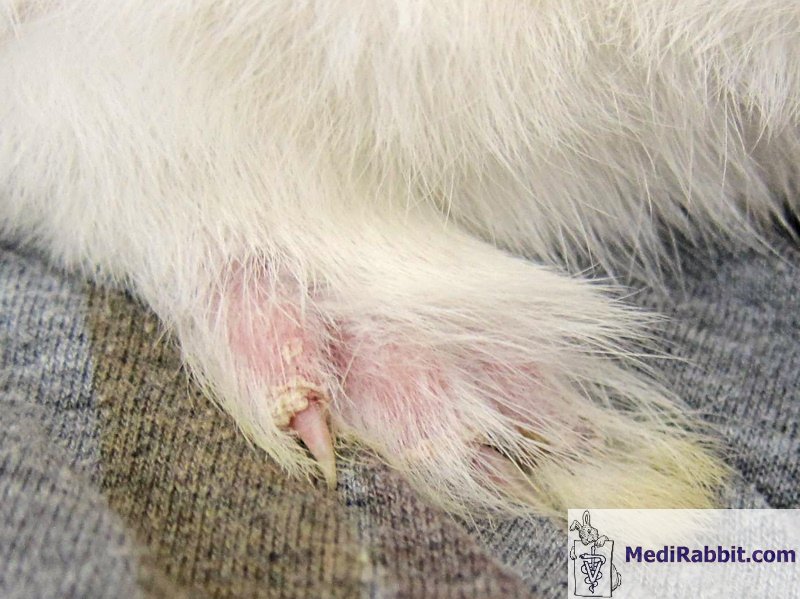
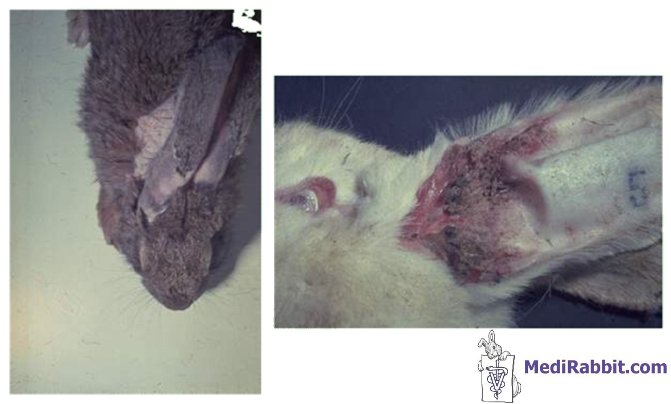
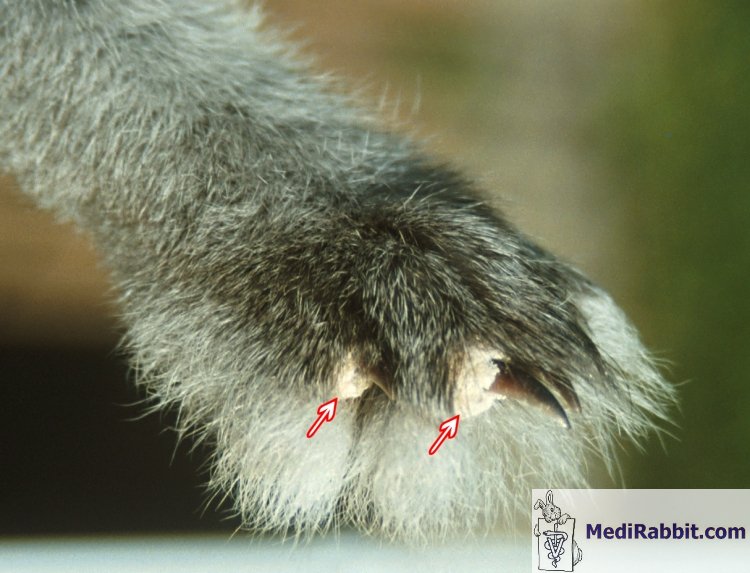
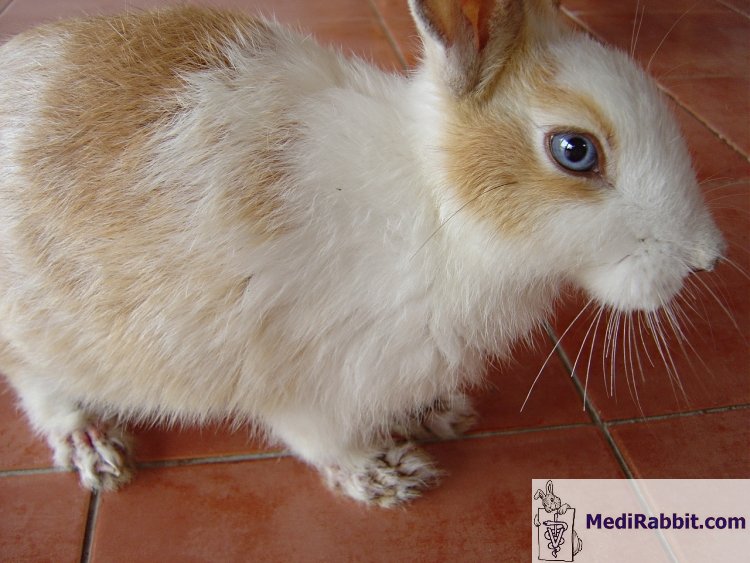
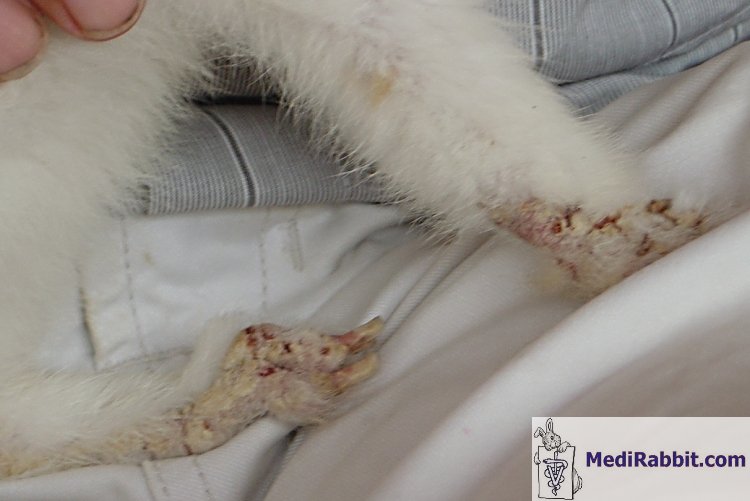
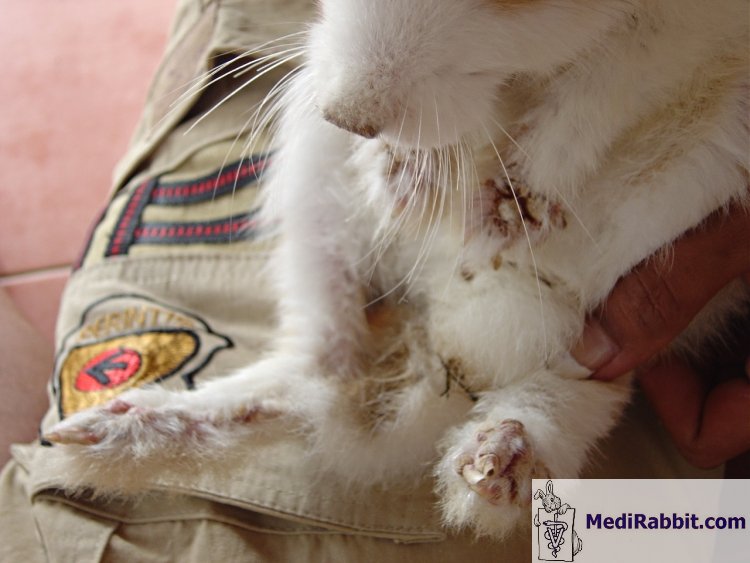
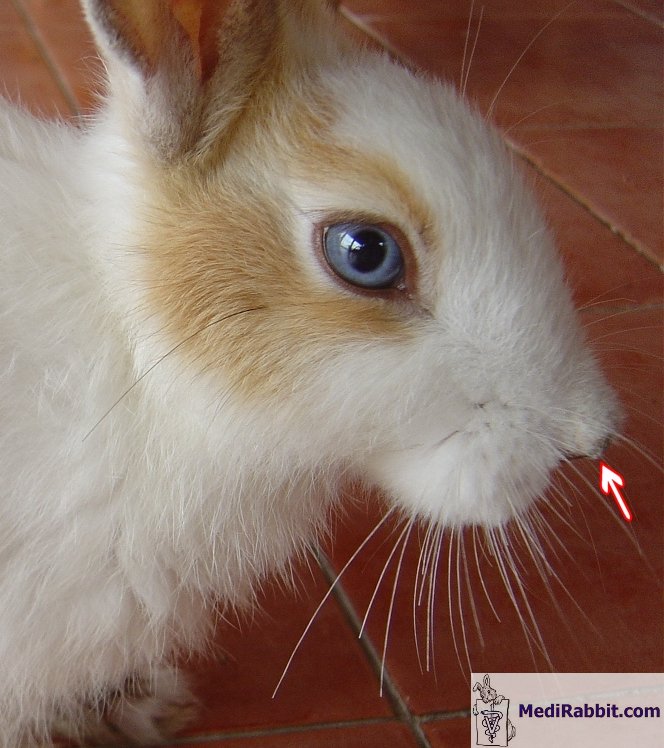
Wounds
appear first on the lips and nose, later around the head, neck, and sometimes
around the genitalia. Burrowing mites (mange) will lead to heavy scratching
by the rabbit, which will also lick the affected areas. This leads to
alopecia (loss of fur). Often one can observe the secretion of a watery stuff
that forms crusts upon drying. Self-mutilation will lead to wounds and
secondary bacterial infection.
Severe infestation leads to
anemia and leucopenia (decrease of white cells in the blood). The rabbit
becomes lethargic and can die within a few weeks.
Diagnosis
Diagnosis can be difficult and visual
examination is not always sufficient to confirm the presence of these mites.
Detection methods include the tape method, skin scraping (shallow if fur
mites are suspected, deep if burrowing mites are suspected), or the vacuum
aspiration method on a filter paper. Samples from scraping or aspiration
should be spread on a microscope glass, dissolved in KOH, and examined under
a microscope. Great is the chance to see a at least
one mite or a larva or eggs. Fur can also be sampled, dissolved in KOH, and
examined under the microscope for the presence of eggs. If no mite is present
in the first sample, other places on the body should be checked. If the
presence of burrowing mites is suspected, but none found after a deep skin
scraping, a biopsy on the area suspected of mite infestation is advisable.
Treatment
Mange
is treated with 3 injections of ivermectin, one every 14 days. The
environment should be thoroughly cleaned, as the mite can survive for weeks
without the presence of the rabbit host. Wounds can be treated with benzyl benzoate
every 5th day.
Moxidectin (Quest® or Equest®
- Fort Dodge) has proved efficacious in treating sarcoptic
mange in rabbits. It has so far not shown secondary effects in rabbits when
administrated orally, while secondary effects have sometimes been observed
after subcutaneous administration.
Sarcoptes scabiei can infest dogs, cats, and man.
If the sarcoptic mite infestation is not resolved,
the presence of dogs and cats, both possible asymptomatic carriers, or of
parasites that survived the treatment should be considered.
If the affected rabbit presents
severe anemia, a transfusion of blood can be attempted from a healthy donor
rabbit.
Burrowing mites (live on/in the
skin) can fall off and contaminate the environment. While treating for mites,
careful cleaning of the cage and environment is recommended. Treatment of the
environment is important (boric acid such as Fleabusters®;
Vet-Kem Acclaim Plus® - Sanofi; Staykil®
- Novartis; Indorex® - Virbac;
acaricide spray). When treating a carpet, vacuum
first in order to further penetration of the spray or powder. Shampooing and
steam cleaning are not ideal; their residual humidity can increase the mite
problem. During treatment of the environment, rabbits should be kept in
another part of the home to avoid the danger of contact with the products.
For further information on Sarcoptes
scabiei in rabbits, see: “Skin Diseases of Rabbits”, by E. van Praag, A. Maurer and
T. Saarony, 408
pages, 2010.
Acknowledgements
Thanks are due to K. Hermans, DVM (Kliniek voor Pluimvee en Bijzondere Dieren, University of Gent, Belgium), to Z. Aizenberg,
DVM (The Koret School for Veterinary Studies, The
Hebrew University of Jerusalem, Israel), to Einam Livnat, and to Berend Bakker (Indonesia) for the permission to use their
illustrative material.
Further ReadingsBeck W. Farm animals as disease
vectors of parasitic epizoonoses and zoophilic
dermatophytes and their importance in dermatology. Hautarzt. 1999;
50(9):621-8.
Cerny V, Rosicky
B. Mammals as source of ectoparasites in towns. Folia Parasitol
(Praha). 1979; 26(1):93 5.
Isingla LD, Juyal
PD, Gupta PP. Therapeutic trial of ivermectin against Notoedres
cati var. cuniculi infection in rabbits. Parasite.
1996; 3(1):87-9.
Nfi AN. Ivomec,
a treatment against rabbit mange. Rev Elev Med Vet
Pays Trop. 1992; 45(1):39-41.
Wagner R, Wendlberger U. Field efficacy of moxidectin in dogs and rabbits naturally infested with Sarcoptes spp., Demodex
spp. and Psoroptes spp. mites. Vet
Parasitol. 2000; 93(2):149-58.
|

e-mail: info@medirabbit.com
